What are you doing at any one moment?
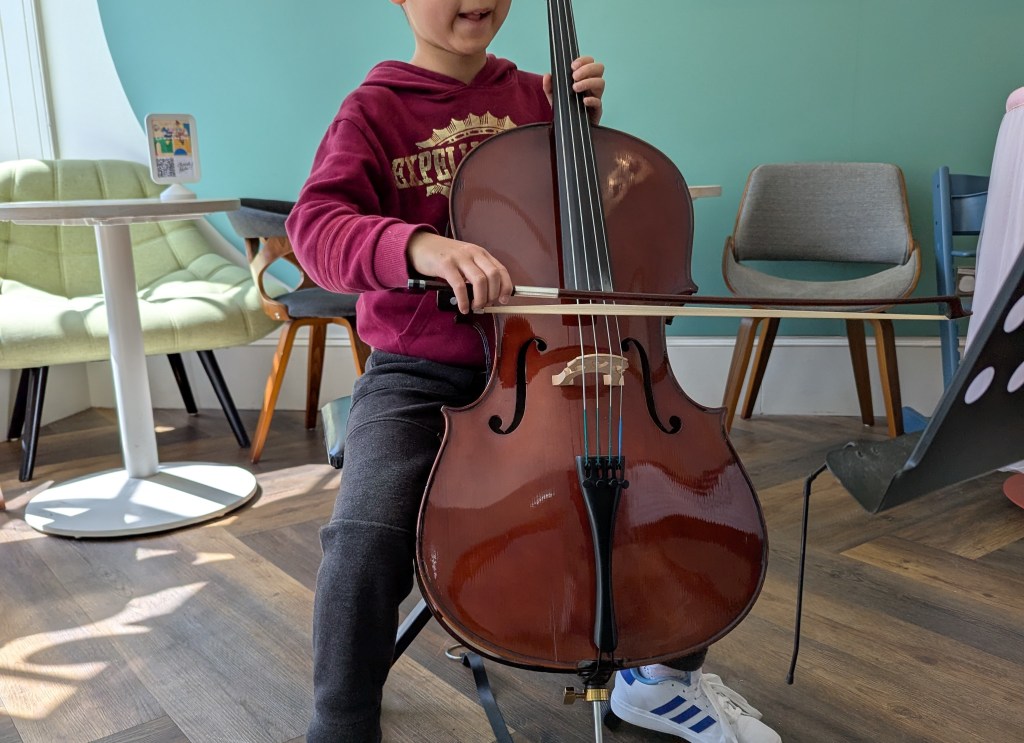
I am an armchair cellist. I sit on an armchair for hours while the cello teacher teaches my child. That made me think of the Markov Model, which basically looks at all the possible states and the transitions probabilities between each state.
A cellist will most of the time have a cello, two hands (each with a thumb and 4 fingers) and a bow. A cello has 4 strings. The bow has a finite length and moves in two directions, push and pull. There are notes and beats (rests) in music theory.
Markov is about describing every state on what the cellist can be doing and the transition between each state. The following sections look at the left hand, right hand and the music and how music can be made in combination (or noise in my case).
Take cello baby steps – left hand
The left hand tends to be placed on the neck and the 4 fingers run along the fingerboard. The four fingers can be placed on the strings to change the note. In the first position, there are 16 different notes can be played with each single finger. There are 4 open strings possibilities too. There are 4 positions (1st to 4th) and 3 half steps positions (7). Shifting between 1st and 4th position, there are 7×16 = 112 states of what the left hand can be. (+4 open strings). The forward extension and backward extension means 2(extensions) x4(strings)x7(positions) so 56 states. The left hand can be in 172 states. (excluding bar technique, where a length of the finger presses against more than 1 strings, thumb on the lower part of the fingerboard, and only considering the single finger tip pressed down scenario)
In summary, there are movements between these states, shift (move up and down), stretch (forward or backward extension) and switch string (twist motion to reach different strings).
Right hand bow.
The bow movement is probably the most complex part of the playing the cello. There 4 strings are arranged so the angle of the bow can play different strings or two strings at the same time. There are 7 distinct angles that the bow is likely to be in. The bow length can be divided into 2 segments (upper half and lower half (hold this end). The bow can move in 2 directions. (2) In music there are different beats from 4 to 1/4. If a slow speed reaches 4 beats with the whole bow then, 2 beat will be half bow. slow speed x 2 will equate to 1 beat half bow. slow speed x4 will equate to half beat. Speed and location on the bow are continuous variables, therefore some sort of discretisation will make it more manageable. I will discretise into (3) speeds. The bow length is further divided into quarters to achieve the 1/4 beat. Let’s group all the numbers. The right hand at any moment is holding the bow on 7 possible angles, moving at 2 possible directions, moving at 3 different speeds in 4 possible locations on the bow. 7 (angles) x 2(directions) x3 (speeds) x 4 (locations) = 168 states. What about pizzicato? Let’s assume one string is plucked so another + 4 states. The total accounted states here are 168 states.
What about the trajectory of the bow? I think the bow speed is very complex. The force is constantly changing from acceleration, deceleration, change in direction and constant speed. The bow runs inline with the end of the finger board most of the time, however, the bow can move nearer to the bridge at different speeds to find different sounds. That is moving towards a more advanced level of playing. (My armchair expertise have not reached that yet)
The left hand and right hand combine to be about 172×172 = 29584 states. It is worth to note that bow speed is very complex. The force is constantly changing from acceleration, deceleration, change in direction and constant speed.
Add the music
Music has legato and staccato, which are played smoothly or separately which has a relationship with the bow direction. The bow direction changes to play staccato notes, and the length of the bow for a legato. The dynamics describe the loudness and softness, which appears to be able to be achieved by bow pressure or bow speed (energy exerted), more energy spent will probably result in more sound energy. There is the rest, which can be achieved by non-contact between the bow and the string, +1 state; bow moves away from string.
The strings are arranged musically from high to low; A, D, G, and C. and combined with the music circle of 5ths make musical patterns that are pleasing to our ears. The cellist by playing through the music (likely to be supervised by a teacher) will practise the more common and useful transitions between the more common states. For example, the cellist will likely use different fingers from the first position instead of shifting from 1st to 2nd position and to 3rd position to play different notes with the same finger.
In summary, I think there are 29,584+1 states which describe what the cellist is doing at any one moment (with simplification and excluding numerous techniques) and how the cellist will transition to the next state.
An artificial intelligent way to approach?
I think Markov Model can be applied to playing the cello. Markov model is basically defining every single thing you can do with the cello and we assume one thing can lead to another other thing you can do. It may or may not make sense. The difficult part will be to update this (29,585 x 29,585) transition matrix between the first note to the second note. Then apply this matrix again to get to the third note. Unsupervised learning is basically giving a cello to a person (with a long life expectancy) to explore moving from one state to another. So we need to move from unsupervised learning to supervised learning with teachers and books.
 Be a Scholar Tuition
Leave a comment