The Road Map
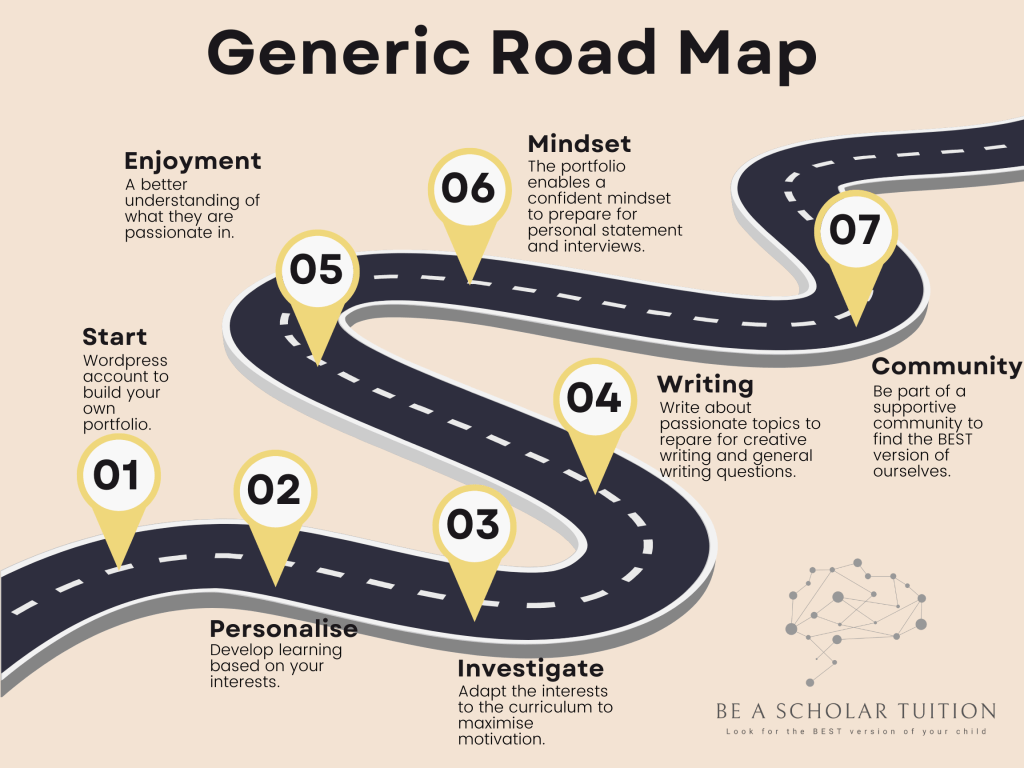
The approach is based on motivation and interests. The free WordPress account will enable the student to create a portfolio to show progress and demonstrate as evidence in future personal statements and interviews.
The generic road-map is shown in Figure 1 below.
Introduction to writing
The General papers and the English creative writing form a big part of the King’s Scholarship. Each writing opportunity has the potential to make an impactful impression on the examiners. Therefore at BE a Scholar Tuition, we will look at the techniques and hone your skills through writing and more writing. Let’s assume that each candidate is decent at Mathematics and the Sciences, so all the answers would be similar or primarily correct. How the candidate writes would become a key differentiator. Their writing will be reflected in the English paper, General papers, personal statement and how the candidate may come across in the interview. Individuality will be important here. You are good at academically because you want to achieve your aspirations and for those knowledge and skills to be part of your life.
At BE a Scholar Tuition, we focus on an efficient system of study. There are other supplementary episodes that will be arranged in a course in the future.
How to write?
Build your ideas and style
The first step is to create some ideas. The ideas can be based on your interests and passions. The second step is to match the idea with a writing style. The common writing styles are listed below:
- Narrative Writing: This style tells a story or recounts an event, often in a chronological order.
- Descriptive Writing: This style uses sensory details and vivid language to create a picture in the reader’s mind.
- Expository Writing: This style explains, informs, or describes a topic, often in a factual or objective manner.
- Persuasive Writing: This style attempts to convince the reader to take a particular viewpoint or to take a particular action.
- Creative Writing: This style includes fiction, poetry, and other imaginative works.
- Academic Writing: This style is used in academic settings and often involves research and the use of formal language. (Most effective with a good understanding of the scientific approach)
Research which aspects to improve
The purpose of practice is to improve certain aspects of your writing, which will depend on the purpose and goals of the writing, as well as the audience and context. However, clear and concise writing (active voices), logical organisation (a clear outline), and engaging and vivid language (expand vocabulary and avoid repetitions) are generally important in all types of writing.
Give writing a try
- Narrative writing can start from your favourite day out, like going to support your football team.
- Descriptive writing can be based on a special moment that you want to share with the reader.
- Expository writing can start from Sciences, e.g. explain what an atom is.
- Persuasive writing (requires classical rhetoric)
- Creative writing, write your own fictional story
- Academic writing, best to focus on expository writing to build a strong scientific foundation.
You can brainstorm the key topics once your idea and style are fixed. The next step is to organise your ideas into an outline. The outline gives a clear structure to guide the reader through your ideas. You are ready to write.
In summary
Practice is the key to improving your writing. There are many different writing styles to choose from. Each style will have their respective aspects to improve. You can start to write by combining your ideas with a style and build an outline to structure your writing. I will create more diagrams to convey the approach and message.
Link to the Episode on Outlines.
 Be a Scholar Tuition
Leave a comment