The Road Map
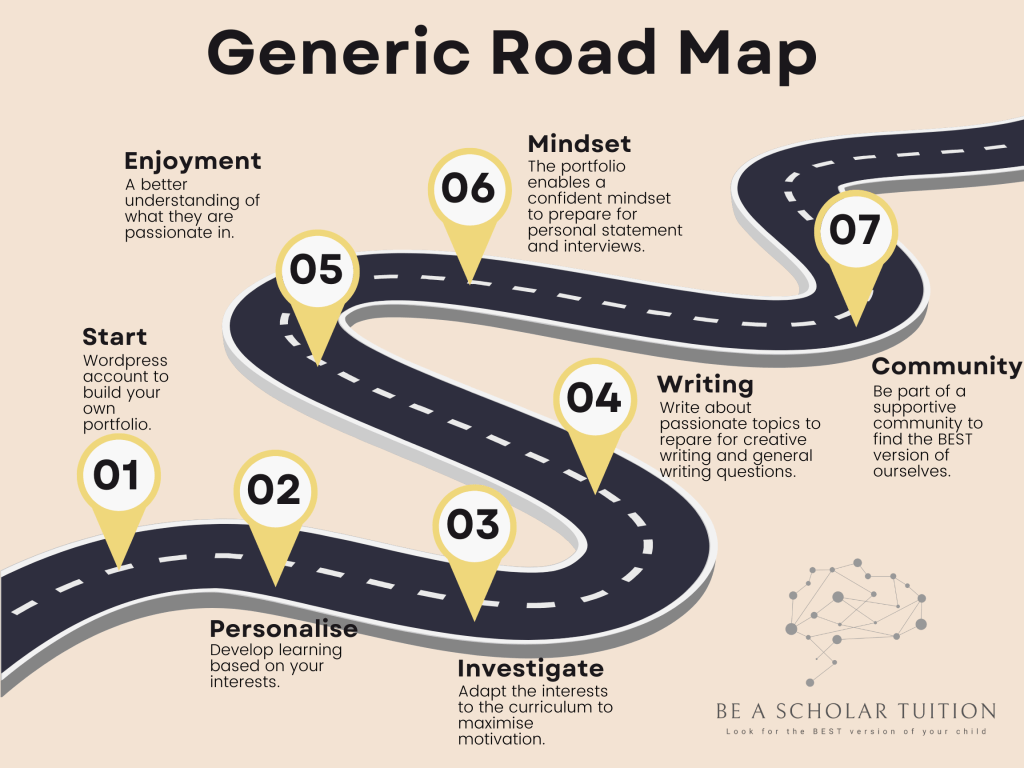
The approach is based on motivation and interests. The free WordPress account will enable the student to create a portfolio to show progress and demonstrate as evidence in future personal statements and interviews.
The generic road-map is shown in Figure 1 below.
Introduction to the Personalisation
Personalisation can be adapted by yourself and along with your parents. The whole process can be done with passive suggestions in future weekly posts.
For the £10 per month Reader subscribers, access to the premium content will enable you or your child to create that plan to pursue academic excellence. New articles will help guide and develop your portfolio and learning journey. Ad-hoc 30-minute ZOOM sessions (£40 each) can be arranged by request through information@beascholartuition.co.uk to refine the plan.
If you and your parents would like active suggestions from BE a Scholar Tuition then the Scholar subscription will be suitable for you.
For the £80 per month Scholar subscribers, BE a Scholar Tuition will arrange a ZOOM session to “know the child”. The deliverable of the session is a development plan for the child through the process below.
Step 2: Personalisation – assume you have completed Step 1.
Know the child – Ensure the WordPress account is in private and use an Alias like “Your favourite sweet – favourite food – random number.” e.g. gummybear_burger2000.
- The first blog post – Introduce themselves. – covered in Episode 18, which is essentially an about page, which will provide leads for the potential sources of motivation. Why I would want to find out more.
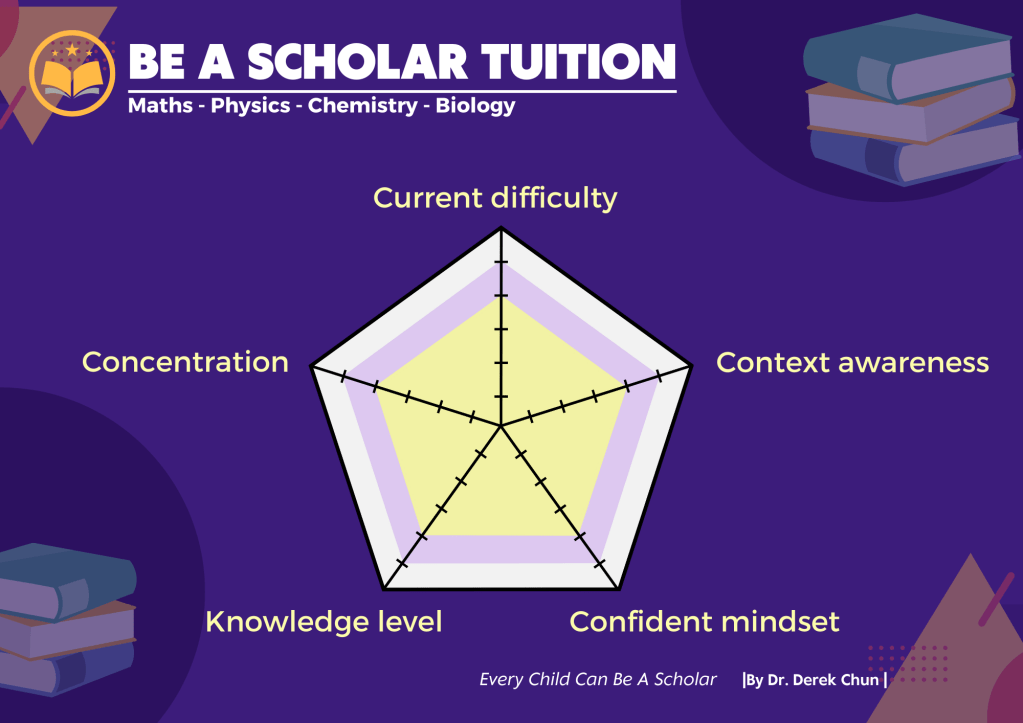
- Use the 5-point template in Figure 2 for each subject for a self assessment (for £80/mth subscribers, BE a Scholar will arrange a session to discuss and two 30 minutes sessions to review each month)
- Current difficulty – based on the average previous two of grades of the same subject – 100% = 5, 80%-99% = 4, 60%-79% = 3, 40%-59% = 2, <40% = 1. Describe in a few sentences how you find the subject.
- Context awareness – Give a number based on 1 (does not want to start) to 3 (I learn this because the teacher said so) to 5 (very motivated I want to find out more) rate your motivation to study this subject.
- Confident mindset – What is your mindset on this subject? Absolutely impossible (1), Impossible (2), I will understand with guidance (3), I will understand with more time (4), Easy leave it to me! (5)
- Knowledge level – How much do you know? I know nothing (1), I don’t know is more than I know (2), I know more than I don’t know (3), and I know a lot about this subject (4), I know everything there is to know about this subject (5). The current difficulty will inform the rating. However, performance in exams / grades can vary on the day.
- Concentration level – The focus here is the quality of the study time. How long can you concentrate? Less than 10 mins (1), 11 to 20 mins (2), 21 to 30 mins (3), 31 to 40 mins (4), and 41 to 50 mins (5). Typically a school lesson is about 50 mins.
- Record the subject, score and date – for revisiting in the future to make a systematic approach.
Another background story (There will be loads of these)
I recall one of my childhood memory was that I had a toy F1 car (1992 McLaren Honda Senna) when I was 10 years old. I was in Hong Kong, thousands of miles from being part of a Formula 1 team. I recall the red-white livery and Honda logo, and the yellow helmet. I really had a wonderful time at the F1 Team even though it was not on the to-do list when I was 10. Would it be great if we can inspire young people that subconsciously, anything is possible?
Physics and Mathematics are critical topics in Engineering, especially numerical integration (Ask me if your are interested) which is really area underneath a graph. Working out areas within shapes is a small step towards that. Chemistry is vital in the behaviour of rubber of the tyre. Biology can relate to the understanding how human drivers can maintain total concentration for 2 hours of race duration and under high accelerations. English and comprehension are vital for understanding and interpreting the Formula 1 rules and regulations to find competitive advantages, like Brawn GP in 2009. The car livery relies on the creativity of the artists and designers. Promotional events, journalists and team press require an excellent command of English and other languages to be effective. The wind tunnel requires model makers and aerodynamicists to find the speed. There are logistical challenges to moving the cars, equipment and personnel to the races. The amount of organisation and teamwork to put two cars on the starting grid are mindblowing.
Whatever topic you choose, you can deep dive into the details and understand the context of what you are learning in relations with your aspirations will provide motivation to continuously improve and find that BEST version of yourself.
In Summary
The second checkpoint is to find out how well the child knows themselves, and quantify their subject in a 5-point diagram to identify which aspect to focus on.
 Be a Scholar Tuition
Leave a comment